 Chinese


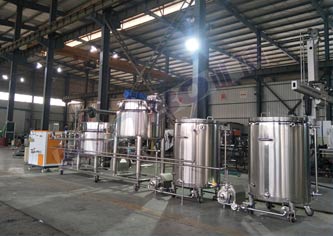
Tailings Dry Discharge & Comprehensive Utilization
Product Details
Current Situation of Tailings in China
China has accumulated over 6 billion tons of various tailings, with an annual production of approximately 160 million tons. However, the comprehensive utilization rate of tailings is only 18.9%, and the vast majority of tailings remain unused. In recent years, the comprehensive utilization and treatment of tailings has increasingly drawn national attention. With the continuous expansion of mineral resource extraction, the annual discharge of tailings will keep rising, making accelerated tailings treatment and comprehensive utilization an urgent task.
Methods for Comprehensive Utilization of Tailings
1. Advanced technologies and proper processes can be used to reprocess tailings, maximizing the recovery of valuable components and reducing the overall volume of tailings.
2. Tailings can serve as raw materials for construction, such as cement, cast stone, ceramsite, concrete aggregates, tiles, glass, and more.
3. Tailings can be used as backfill material in underground mine voids, either as water-sand fill or cemented aggregate. After discharge from the beneficiation plant, tailings are classified: coarse sand is sent to underground voids, while fine particles are stored in tailings ponds.
4. Tailings can be used for land reclamation, such as soil coverage for planting crops or afforestation.
5. Tailings materials can be used for road construction, pavement materials, and anti-slip surfaces.
Tailings Dry Discharge Process Flow Diagram
Option 1: Full Tailings Dry Discharge

Option 2: Graded Dry Discharge

Various Filtration Equipment

High-Efficiency Cyclone Separator

Under pressure, the feed slurry enters the cyclone along the line direction. In the centrifugal field, coarse particles are thrown to the cyclone wall and move downward with the outer vortex, discharging through the underflow sand outlet to obtain coarse-grained sand. Fine particles move upward with the inner vortex and exit through the overflow pipe to obtain fine-grained overflow products.
Typically, small-angle conical or multi-conical cyclone structures are used to increase the concentration and yield of the underflow.
Main Technical Parameters of the Cyclone:

GNZ Center-Drive High-Efficiency Thickener

The GNZ series center-drive thickener adopts a modular design. The machine is composed of modules including the tank, support, drive, feed, discharge, rake frame, and rake lifting system. Multiple optimizations have been made in feeding, discharge, overflow, and control methods. The new structure and control system accelerate material settling, increase processing capacity per unit area, and reduce overflow turbidity.
Applications:
1. Concentration, washing, and dewatering of concentrates in wet mineral processing, and concentration and dewatering of tailings;
2. Suitable for thickening and clarification of slurry containing solids in coal, steel, chemical, building materials, cement, wastewater treatment, etc., according to different material properties and process conditions;
3. Widely used in both metallic and non-metallic concentration operations.
Features:
1. Integrates high-efficiency thickener sedimentation theory and design concepts, offering high processing capacity per unit area and excellent dewatering, enabling efficient operation;
2. Modular design achieves seamless integration of mechanical, electrical, and hydraulic systems;
3. Fully functional, series-based control system maximizes thickener processing capacity and effectively prevents rake jamming accidents;
4. Comprehensive fault-handling protocols ensure worry-free operation of the thickener.
GNZ Series – Technical Specifications:

Vacuum Belt Dewatering Machine for Tailings

Working Principle:
This equipment uses a fixed vacuum box. The endless rubber belt, driven by a reducer, runs continuously over the vacuum box. Filter cloth is laid on the rubber belt and moves synchronously. The rubber belt contacts the friction belt on the vacuum box sliding table, forming a watertight seal. Slurry is evenly distributed on the filter cloth through the feeding hopper. When the vacuum chamber is connected to the vacuum system, a vacuum filtration zone is formed on the rubber belt. The filtrate passes through the filter cloth, collects in transverse grooves on the belt, and enters the vacuum chamber through small holes. Solid particles are retained on the filter cloth, forming a filter cake. The liquid entering the vacuum chamber is discharged through the filtrate tank. As the rubber belt moves, the formed filter cake sequentially enters the washing and drying zones. The filter cloth separates from the belt and moves to the discharge area. After the filter cake is removed, the cloth is cleaned and regenerated, passes through a set of support rollers and a deviation correction device, and re-enters the filtration zone for the next filtration cycle.

Features:
● Feeding, filtration, filter cake washing, filter cake dewatering, discharge, filter cloth regeneration, and cloth deviation correction are continuously and automatically completed, achieving a very high degree of automation.
● Filtrate and filter cake washing liquid can be collected separately; multi-stage co-current and counter-current washing of the filter cake is possible, with each stage of washing liquid collected independently.
● Remote and on-site interactive control is available, enabling unattended operation.
● Belt speed is steplessly adjustable within a certain range, allowing adjustment of filter cake thickness according to material filtration properties for optimal filtration performance and strong adaptability.
● The entire machine uses a frame modular design, facilitating transportation, installation, and maintenance.
● Filter cloth regeneration can be enhanced with optional high-pressure cleaning to improve regeneration efficiency and extend service life.
● Liquid discharge methods include zero-level discharge, high-level discharge, and auxiliary discharge.
● The equipment can be fitted with a gas hood for semi-closed or fully enclosed operation, suitable for materials containing volatile gases or vapors, providing localized heat retention or centralized collection for cleaner production.
Specifications


Working Principle
The filter plates immersed in the slurry tank adsorb solids through the capillary pores under vacuum, forming a layer of filter cake on the surface. The filtrate flows from inside the plates through piping to the discharge tank. A rotor moves the filter plates and the adsorbed filter cake to the drying zone, where vacuum continues to dewater the cake. After drying, the rotor moves the plates to the discharge zone (without vacuum), and a ceramic scraper removes the cake. The cleaned plates enter the backwash zone, where industrial water or compressed air flows through the backwash pipes to clean the internal pores of the ceramic plates from inside out. Periodically, ultrasonic cleaning combined with low-concentration acid ensures efficient use of the ceramic plates.


SSYHorizontal Belt Pressure Filter

The SSY Horizontal Belt Pressure Filter is a modern filtration device, primarily composed of the main machine, electrical control system, hydraulic control system, air-drying system, and feeding system. During operation, the filter chamber is first closed, and the material enters the chamber under pressure from the feed pump. The pressure difference across the filtration medium separates solids from liquids. Solids are retained in the filter layer, while the filtrate passes through the filter cloth and exits the machine. After a period, when filtrate flow stops, the filtration and dewatering process is complete, and feeding is stopped. High-pressure pressing and compressed air drying are then applied to the filter cake. The device is opened, and the drive rollers move the filter cloth to discharge the cake. The filter cloth is then cleaned with a high-pressure air spray before starting the next filtration cycle.
The equipment features simple structure, high automation, low failure rate, and easy maintenance.
Features:
1. Automatic high-pressure pressing of the filter cake, with pressing pressure up to 1.0 MPa, combined with high-pressure air to minimize moisture in the cake.
2. Automatic high-pressure water cleaning of the filter cloth ensures cloth regeneration, extends filter cloth service life, improves filtration efficiency, and reduces water consumption.
3. Short-stroke filter chamber opening/closing mechanism allows quick operation, shortening filtration cycles; hydraulic drive enables high-speed filter cloth movement; each cycle takes approximately 4 minutes, ensuring high work efficiency.
4. Filter chamber locking device provides self-locking functionality, enabling fully automated and intelligent operation and monitoring for safe and reliable performance.

Technical Specifications

The SPF is a high-efficiency solid–liquid separation device integrating high efficiency, energy saving, and intelligent control. It fully utilizes the feed pump pressure, material properties, and diaphragm pressing force, using filter cloth as the medium to separate solids from liquids in the slurry.
Features
1. Stacked filter plate structure with auxiliary guiding devices for more reliable operation;
2. Integrates filtration, pressing, washing, drying, discharge, and filter cloth regeneration into one efficient process;
3. Pressing pressure up to 1.6 MPa, widely suitable for applications with varying filter cake moisture requirements;
4. Hydraulic drive control for stable and reliable operation with low energy consumption;
5. Integrated PLC, touch screen, and automatic control instruments for efficient and convenient operation;
6. High-pressure water cleaning system ensures better filter cloth cleaning;
7. Circular chamber design provides a more reasonable structure and enhanced performance.
Process Flow: Feed → Filtration → Pressing → Washing → Air Drying → Discharge


