 Chinese


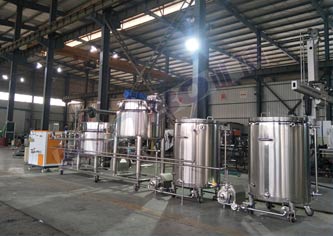
Rubber Belt Vacuum Filter
Rubber belt vacuum filter for continuous solid-liquid separation. Stable operation and high capacity, widely used in mining, chemical, and environmental industries.
Product Details
★ Equipment Overview
The rubber belt vacuum filter is a high-efficiency solid–liquid separation device that uses filter cloth as the filtration medium. It fully utilizes material gravity and vacuum suction to achieve effective solid–liquid separation.★ Working Principle
The equipment adopts a fixed vacuum box design. The endless rubber belt is driven by a reducer and runs continuously over the vacuum box. The filter cloth is laid on the rubber belt and moves synchronously with it. The rubber belt contacts the friction belt on the vacuum box sliding table to form a water-sealed structure. Slurry is evenly distributed on the filter cloth through the feeding hopper. When the vacuum chamber is connected to the vacuum system, a vacuum filtration zone is formed on the rubber belt. The filtrate passes through the filter cloth, flows into transverse grooves on the rubber belt, and enters the vacuum chamber through small holes. Solid particles are retained on the filter cloth, forming a filter cake. The liquid entering the vacuum chamber is discharged through the filtrate tank. As the rubber belt moves forward, the formed filter cake successively enters the washing zone and drying zone. The filter cloth separates from the rubber belt, and the filter cake is discharged at the discharge roller. The filter cloth is then cleaned and regenerated, passes through a set of support rollers and a deviation correction device, and returns to the filtration zone to begin the next filtration cycle.
★ Equipment Features
● Modular structural design allows flexible assembly and convenient transportation. The machine can also be transported as a whole after installation and commissioning.● The filter cloth runs synchronously with the rubber belt, enabling continuous feeding, filtration, washing, drying, and filter cloth regeneration.
● The control system supports both remote and on-site interactive control, enabling unattended operation.
● Multiple rubber belt support methods are available, including roller type, air cushion type, tray type, and multi-friction belt support, reducing friction resistance and extending belt life.
● Washing liquid can be collected in stages, and both co-current and counter-current washing methods are available.
● High-pressure cleaning systems can be optionally installed to improve filter cloth regeneration efficiency and service life.
● Various filtrate discharge methods are available, including zero-level discharge, high-level discharge, and auxiliary discharge.
● The equipment can be equipped with a gas hood or aluminum-plastic windows to achieve semi-closed or fully enclosed structures, suitable for materials containing volatile gases or vapors and for heat preservation or centralized gas collection.

A、Feeding Device B、Washing Device C、Filter Cloth D、Friction Belt E、Cleaning Device F、Rubber Belt G、Deviation Correction Device
H、Filtrate System (Filtrate Main Pipe / Vacuum Main Pipe) I、Switching Valve J、Liquid Separator (Discharge Tank / Vacuum Tank) K、Washing Pump L、Vacuum Pump

The equipment model can also be designed according to site conditions and material characteristics.
Currently, it is widely used for solid–liquid separation in industries such as metallurgy, mining, petrochemical, chemical processing, coal washing, papermaking, fertilizers, food processing, pharmaceuticals, and environmental protection. Typical applications include gypsum dehydration in flue gas desulfurization systems and tailings treatment.


